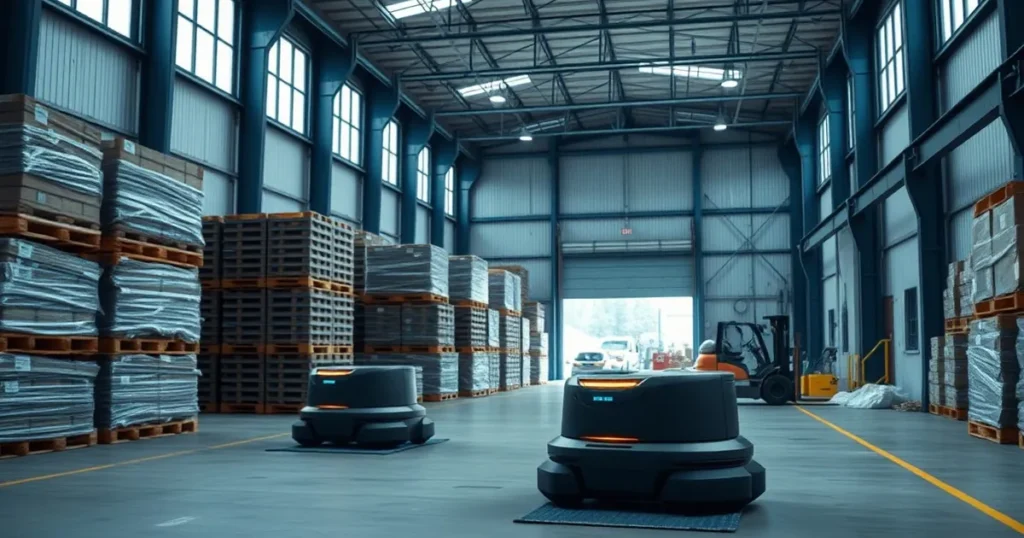

Canada’s AI debate just got more concrete. The conversation is no longer only about software that writes emails or summarizes meetings; it is about physical AI — systems that move through warehouses, roads, factories, and other real-world environments — and about whether Canada can keep the economic value of that technology at home.
What physical AI really changes for AI automation Calgary
Physical AI is a useful phrase because it forces people to stop pretending AI lives only in a browser tab. Once AI is tied to machines, sensors, logistics, and industrial workflows, the stakes change fast: safety, uptime, liability, and control all matter more than a slick demo.
For Canadian businesses, that means the conversation shifts from “Can this draft a response?” to “Can this system reliably operate in a warehouse, on a job site, or inside a regulated process without creating a mess?” That is a much harder test, and it is where a lot of vendor hype starts to crack.
At DAvision, our Calgary clients see this same pattern when teams move from isolated AI experiments to real operational automation. The value is there, but only if the workflow is tightly scoped and the failure modes are understood.
Why economic nationalism is now part of the AI automation Calgary debate
The nationalism angle is not just political theatre. It is a response to a very practical Canadian problem: we often adopt foreign technology, pay for it in foreign currency, and then watch the long-term value — data, IP, procurement power, and platform control — drift elsewhere.
That matters in Alberta as much as anywhere. Oil and gas, construction, logistics, and professional services all depend on systems that can be bought, integrated, and supported without making a company hostage to a single foreign vendor or a fragile supply chain.
This is where Canadian business owners should be paying attention. AI automation Calgary is not only about saving labour hours; it is also about deciding whether the automation stack is something your company can actually own, audit, and adapt over time.
The real winners are not always the loudest AI vendors
The biggest winners in physical AI are likely to be the companies that can combine software with operational discipline. That includes firms that understand industrial environments, not just model demos.
The losers are the businesses that buy too early, over-trust the pitch, and discover that a system built for a clean lab environment struggles in a noisy, messy Canadian workplace. A warehouse in Calgary winter is not the same as a polished product video.
There is also a labour angle that should not be softened. Physical AI will not just “assist” workers in some abstract sense; in certain roles it will reduce the need for human labour, change job design, and put pressure on companies to retrain people faster than they usually do. That is the part executives like to skip over.
Alex’s counterpoint — Alex would say this is exactly why Canada should lean in, not hesitate. If physical AI is going to reshape logistics, manufacturing, and field operations anyway, then Canadian firms need to build competence now instead of waiting for foreign platforms to define the rules. He would argue that the risk is not over-adoption — it is under-adoption, with Canadian companies falling behind because they treated AI as a side project instead of core infrastructure.
What Canadian businesses should do now
Start with the boring question: where does AI actually touch a physical workflow, and what happens when it fails? If the answer involves safety, customer trust, or regulatory exposure, the bar for adoption should be much higher than for a simple internal assistant.
Then look at ownership. Can you export your data? Can you switch vendors? Can your team explain the system to an auditor, insurer, or regulator if needed? If not, you do not have an automation strategy — you have a dependency.
For Calgary and Alberta firms, this is exactly the kind of operational problem DAvision helps untangle through practical automation work, not theory. If you want to see how that thinking extends beyond headlines, our automation work is built around the workflows businesses actually run.
And if you want more reporting on how AI is reshaping Canadian business, you can follow our AI news feed for related coverage.
Canadian companies do not need to become nationalist for the sake of it. They do need to become more selective, more skeptical, and a lot less willing to hand over strategic control just because a vendor says the future is here. If you are mapping that out for your own team, start at davision.ca.